

Tissue Specific Gradient Factors – a modified approach for GF low / GF high

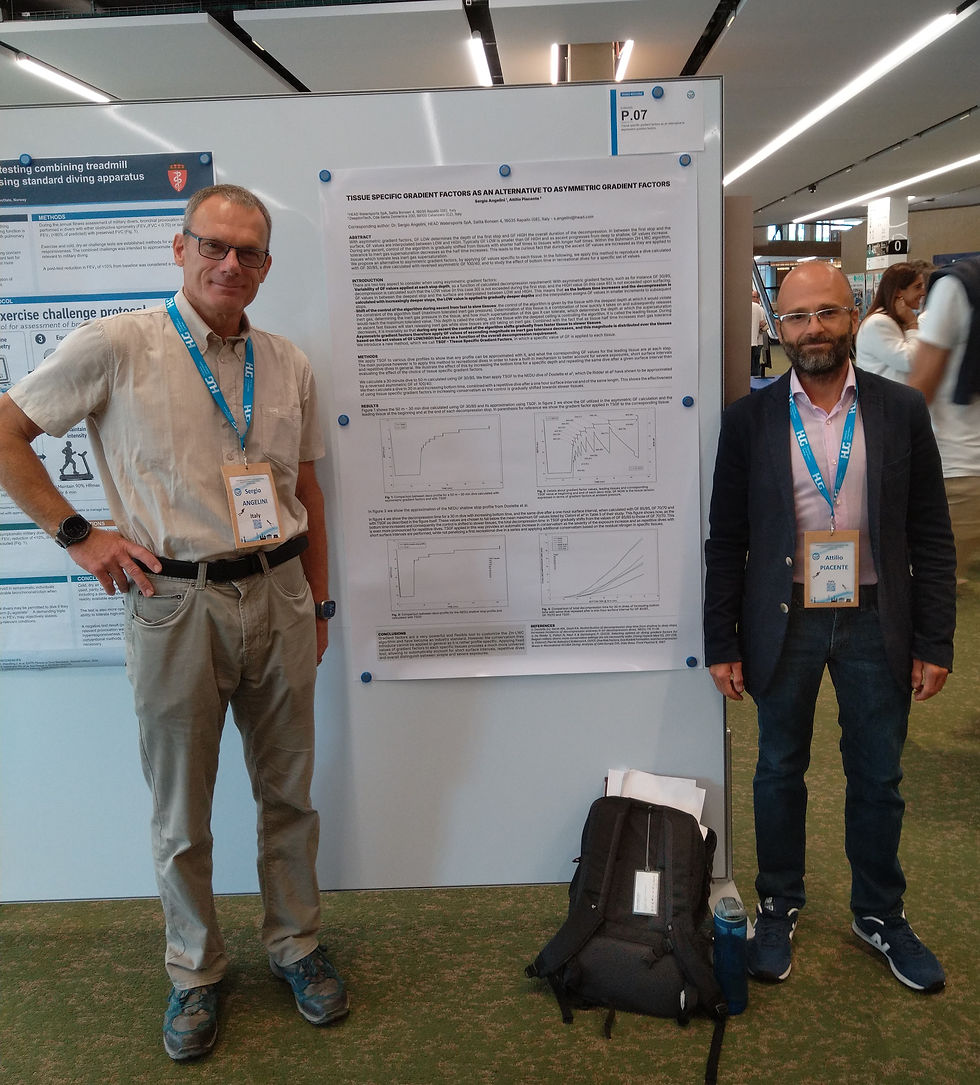
Sergio Angelini of HEAD Watersports and Attilio Piacente of DeepInTech presented an interesting approach to the application of gradient factors at the 2026 EUBS Congress in Geneva. Under the title ‘Tissue-Specific Gradient Factors as an Alternative to Asymmetric Gradient Factors’, they challenge the traditional concept of GF low and GF high. Instead of basing the gradient factor primarily on depth during the ascent, they propose linking it to the individual Bühlmann tissue compartments. They refer to their concept as Tissue-Specific Gradient Factors (TSGF).
The problem with traditional gradient factors
With the asymmetric gradient factors commonly used today – for example, GF 30/85 – GF low is applied at the first decompression stop and is then increased linearly up to GF high at the surface.
The consequence is that the factor used is determined by depth rather than by which tissue compartment is currently controlling decompression.
During the ascent, however, control typically shifts from fast to increasingly slower compartments. At the same time, the Bühlmann compartments differ significantly in terms of the supersaturation they can tolerate. In the classic GF method, the choice of the current GF does not directly take these differences into account: the GF simply increases as depth decreases.
We know that such a rigid application of GF can reach its limits, particularly during very deep dives. Doolette, for example, demonstrated in a comparison of Bühlmann/GF with the Thalmann/XVal-He profiles validated for deep Heliox dives that a fixed GF scheme does not correspond to a constant DCS risk as depth increases. A GF pair that correlates well with a specific risk level at more moderate depths may deviate from it increasingly at greater depths. The relevant considerations can be found in the Rebreather Forum 4 Proceedings.
Tissue-Specific Gradient Factors – how do they work?
Under the TSGF concept, the GF is no longer primarily linked to depth. Instead, each of the 16 Bühlmann compartments is assigned its own GF. During decompression, the GF of the compartment currently leading the process is applied. If the leading tissue changes, the GF used also changes.
Put simply:
It is not the current depth that determines the GF, but the tissue that is currently controlling decompression.
It is important to note that the authors did not derive these tissue-specific GFs from new physiological measurements or DCS data. They initially selected the values so that known decompression profiles could be reproduced as accurately as possible. TSGF is therefore, initially, an alternative mathematical method for distributing the desired conservatism within ZHL-16C.
An example
Angelini and Piacente clearly illustrate the principle using a 50-metre dive with a 30-minute bottom time, for which they replicate a classic GF 30/85 profile using TSGF. In a classic GF 30/85 profile, decompression begins with a GF of 30. The permitted GF then rises continuously as depth decreases, until GF 85 is reached at the surface.
With the TSGF approach, something different happens: in this example, the faster compartments leading at the start of decompression are assigned GF values in the range of approximately 30–40. As medium-speed compartments take the lead later on, values of around 50–60 are applied. For the compartments that take control later on, the values rise further towards the classic high GF of 85.
The result may look very similar to a classic GF 30/85 profile – but the mechanism behind it is different. In the classic method, the GF rises because the dive becomes shallower. With TSGF, the GF changes because a different tissue compartment controls the decompression. This is precisely the central idea of the poster.
Other decompression profiles can also be replicated
The authors do not limit themselves to classic GF profiles. They also demonstrate that a NEDU Shallow Stop profile, as described by Doolette et al., can be approximated by selecting the appropriate TSGF.
This is interesting because it means that TSGF becomes less of a fixed decompression scheme and more of a tool with which diving profiles can be further modulated: by assigning different GF values to the compartments, it is possible to reflect different approaches to how conservatively individual tissues should be treated. This could help to better manage the risk of DCS.
Particularly interesting for long and repetitive dives
Perhaps the most exciting aspect of the poster becomes apparent with increasing bottom time and during repetitive dives. The longer a dive lasts, the more the decompression control shifts towards slower compartments. In the TSGF system, this automatically changes the GF used, as different tissues now take the lead.
The same applies after a short surface interval. During a repetitive dive, different compartments are pre-stressed compared to a single dive. The authors demonstrate that this also alters the decompression calculated using TSGF, which can become more conservative during repetitive dives.
This is a key difference from a fixed GF pair: the conservativeness responds to the change in the controlling compartments and not solely to depth.
And which tissues are actually crucial?
Of particular interest here is the possible role of the intermediate-speed compartments. Very fast tissues have a high tolerance to supersaturation and desaturate quickly during a controlled ascent. Very slow tissues, whilst tolerating less supersaturation, saturate only slowly during many typical technical dives.
The medium-speed compartments lie exactly between these extremes. It is therefore conceivable that they, in particular, could be of greater significance for clinically relevant DCS than one might assume when applying the classical GF model and the simplified discussion of ‘fast’ and ‘slow’ tissues. However, this remains a theoretical consideration based on the model. It is not possible to deduce from the poster which real human tissue corresponds to a particular Bühlmann compartment, nor that a specific compartment has been proven to be responsible for a particular proportion of DCS cases.
What does this mean in practice?
The concept is elegant because it addresses a fundamental weakness in the standard application of GF: GF low and GF high are ultimately two figures chosen by the diver, the specific effect of which depends on when and with which leading tissue they are applied. TSGF, on the other hand, attempts to link the chosen level of conservatism more directly to the Bühlmann compartments.
However, it is important not to lose sight of what the poster actually shows – and what it does not. TSGF is, first and foremost, a mathematical or algorithmic concept. The fact that known decompression profiles, which can be reproduced using models other than the Bühlmann model, can be replicated with TSGF does not necessarily mean that TSGF predicts DCS risk more accurately or actually produces safer decompression profiles.
The problem of validation
This would require experimental and, ultimately, prospective data. And this is precisely where one of the major problems in current decompression research lies: validation under real-world conditions. Studies involving a sufficient number of dives, controlled profiles and clinically relevant endpoints are extremely labour-intensive and costly. It is currently difficult to envisage that the necessary funding on a large scale will be available for the systematic validation of new decompression approaches.
Conclusion
Tissue-Specific Gradient Factors represent an exciting attempt to combine GF with Bühlmann’s tissue kinetics. Rather than simply interpolating between GF low and GF high during the ascent based on depth, each compartment is assigned its own GF. When the leading compartment changes, the gradient factor also changes.
However, the poster does not demonstrate whether TSGFs are actually ‘better’ than classical GFs. Rather, it raises an interesting question for the further development of decompression algorithms:
Why should GF actually depend on depth – and not on the leading tissue controlling the decompression?
Bühlmann remains the standard
For me, the poster also epitomises one of my strongest impressions of the EUBS 2026 in Geneva: there is currently little that is truly new on the horizon. Bühlmann is being modified, GF are being reinterpreted or applied differently, and existing decompression strategies are being compared with one another. By contrast, there was hardly any sign of a fundamentally new approach that goes beyond the familiar models.
More than a hundred years after Haldane and decades after Bühlmann, fine-tuning continues. The basic model, however, remains surprisingly untouched: Bühlmann ZHL-16 is still the most widely used standard.
Literatur:
1) Rebreather Forum 4 Proceedings (2024). Doolette DJ et al. NEDU Technical Report 19-05 (2019): Validation of XVal-He-8_040 and XVal-He-9_040 Thalmann Algorithm parameter sets for computing decompression schedules for extended duration 1.3 atm PO₂ He-O₂ diving with N₂-O₂ decompression.
2) Doolette DJ, Gerth WA, Gault KA. Redistribution of decompression stop time from shallow to deep stops increases incidence of decompression sickness in air decompression dives. NEDU Technical Report 11-06. Navy Experimental Diving Unit, Panama City, Florida; 2011.
further reading on dekoblog.ch:


Kommentare